Why trust matters when buyers search with AI
Trust is the deciding factor when people discover brands through AI-powered answers. When ChatGPT, Google AI Overviews, Gemini, Perplexity, and Claude reference a company, users assume the brand is legitimate and relevant. That assumption AI Visibility Platform means small visibility differences can translate into measurable differences in leads, partnerships, and revenue. A trustworthy brand presence also reduces the risk of being ignored by high-intent audiences.
Unlike traditional search, AI responses can compress multiple signals into a single recommendation-style mention. If your name appears without context, users may question accuracy, and if it appears rarely, they may assume you are unimportant. That is why an AI visibility tracker should focus on quality, not just volume. When you can verify how often and where you are cited, you gain control over how your brand is perceived in the AI layer.
What a quality-first AI presence measurement should include
A quality-driven AI visibility approach starts with measurement that reflects real brand recognition. Botric tracks how often your brand is mentioned and cited across major AI experiences, so you can see whether your presence is becoming part of the knowledge ecosystem. Mentions without citations can indicate shallow awareness, while citations often correlate with stronger credibility in the answer. This distinction helps brands prioritize improvements that lead to more dependable outcomes.
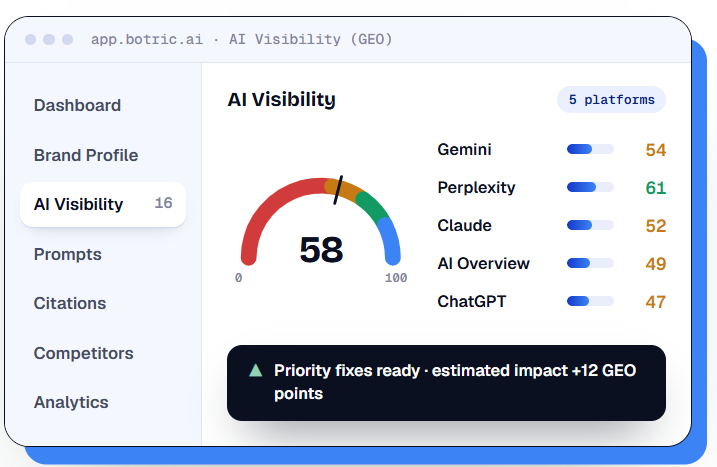
Good measurement also captures consistency across platforms, because each AI system has its own retrieval and summarization behavior. If you perform well in one environment but lag in another, your trust signals become uneven for different audiences. Botric’s approach helps you compare performance across multiple AI experiences such as generative chat and AI overviews. With those comparisons, you can decide where to focus messaging, sources, and content distribution for maximum reliability.
Finally, trust requires transparency in how results relate to brand identity. Variations in naming, capitalization, or product naming can cause fragmented recognition, which weakens citation strength. A quality-first tracker encourages brands to standardize brand signals and maintain clear associations between your company and your offering. That way, mentions are more likely to map to the correct entity, improving confidence for both users and AI systems.
Turning visibility data into credibility signals
Visibility becomes meaningful when you can connect it to actions that strengthen credibility. For example, if you see fewer citations than expected, it may indicate that reputable sources do not consistently reference your brand. You can address that by improving how your company is described across authoritative pages, industry listings, and partner sites. When AI systems find consistent references, they are more likely to cite you in a way that feels accurate to users.
You can also improve the quality of your brand footprint by aligning content with the questions customers actually ask. AI systems often summarize from structured explanations, thought leadership, and third-party references. If your messaging is too promotional, AI summaries may avoid it or present it with lower confidence. By publishing clear, verifiable information—definitions, methodologies, implementation steps, and case-backed outcomes—you increase the chance of being referenced in a helpful, trustworthy manner.
Another credibility lever is consistency in claims and proof. When your public content includes specifics such as measurable results, documented partnerships, and transparent methodology, AI systems have better material to cite. Botric’s tracking helps you validate whether those improvements translate into more frequent, higher-quality mentions. Over time, you build a feedback loop where data guides which credibility assets to expand and which to refine.
How brands use an AI visibility tracker to reduce risk
Trust also means managing the risk of being misrepresented or underrepresented. If your brand is missing from AI answers, prospects may never reach the stage where they evaluate your offering. Conversely, if your brand appears with weak or inconsistent context, it can create doubt before a sales conversation begins. An AI visibility tracker helps you detect those gaps early by showing where and how often you are referenced across key AI experiences.
Risk management extends to reputational consistency. AI systems can surface different facets of a brand depending on which sources they retrieve, and that can lead to mismatched positioning if your online footprint is fragmented. By monitoring your AI brand visibility, you can identify unexpected citation patterns and investigate the underlying sources. Then you can strengthen the most accurate narratives through improved documentation, press references, and authoritative profiles.
Operationally, tracking also supports better decision-making across marketing, PR, and content teams. Instead of debating whether “AI mentions are up,” teams can use visibility metrics to prioritize initiatives with measurable outcomes. That clarity reduces wasted effort and improves coordination when campaigns aim to influence AI-driven discovery. With a quality-first lens, you focus on citations and reliable references rather than chasing vanity metrics.
Conclusion
Building trust in an AI-first discovery environment requires more than awareness campaigns and generic content. It calls for measurable credibility signals that show how often your brand is mentioned and cited across the AI systems people rely on. A quality-focused AI visibility approach helps you see where you stand, understand what changes visibility, and validate the impact of trust-building efforts. Botric’s AI visibility tracking supports that goal by measuring brand mentions and citations across major AI experiences. When you treat AI visibility as a trust metric, you can refine your sources, strengthen authoritative references, and reduce uncertainty for users. The result is a more dependable presence in AI answers—one that improves perception, supports conversions, and reinforces long-term brand credibility.